
Quick Answer: Bad spark plugs cause hard starting, rough idle, misfires, poor acceleration, and reduced fuel economy. They can prevent a car from starting entirely when worn severely or fouled with deposits. The fix is straightforward — replace the plugs. Most 4-cylinder engines take 30–45 minutes DIY. The cost difference between cheap and quality plugs is £20–£40 for a set, and quality iridium plugs last 4–5 times longer than copper plugs.
Last month a neighbour called me — her Volkswagen Golf wouldn’t start. No cranking issue, battery fine, fuel pump working. She’d had warning signs for weeks: rough idle in the morning, occasional hesitation on acceleration, and a slight drop in fuel economy that she’d put down to “winter driving.” Classic spark plug deterioration pattern. Three of the four plugs were well past their service life with rounded, worn electrodes and heavy carbon deposits on one of them.
New NGK iridium plugs across all four cylinders: £38. Time to fit: 40 minutes. Car started immediately and ran smoother than she remembered in a long time.
Spark plugs are maintenance items — they don’t fail dramatically, they deteriorate gradually. Understanding the symptoms helps you catch the decline before it becomes a no-start situation.
What Spark Plugs Actually Do
A spark plug does exactly one job: create a precisely timed electrical spark inside the combustion chamber to ignite the compressed air-fuel mixture. But that one job needs to happen reliably thousands of times per minute, at temperatures up to 600°C, under pressures up to 50 bar, for tens of thousands of miles.
The electrode gap — the distance across which the spark jumps — is critical. New plugs have a gap precisely set to manufacturer specification (typically 0.7–1.1mm). As the plug wears, the electrode erodes and the gap widens. A wider gap requires more voltage to jump — the ignition coil has to work harder, and eventually the spark becomes too weak to reliably ignite the mixture.
Types of spark plugs and their lifespan:
| Type | Material | Typical Lifespan | Relative Cost |
|---|---|---|---|
| Copper | Copper core | 20,000–30,000 miles | Cheapest |
| Platinum | Platinum tip | 40,000–60,000 miles | Mid range |
| Iridium | Iridium tip | 60,000–100,000 miles | Most expensive upfront, cheapest per mile |
| Double iridium | Iridium both ends | 80,000–120,000 miles | Premium |
The total cost difference between changing copper plugs every 25,000 miles vs iridium plugs every 80,000 miles over 160,000 miles of ownership: roughly the same — but iridium requires less frequent work and maintains performance longer.

8 Symptoms of Bad Spark Plugs
1. Engine Won’t Start — Cranks But Won’t Fire
When plugs are severely worn or fouled, they can’t produce a reliable spark. The starter motor cranks the engine over normally — you hear it turning — but no combustion occurs. The engine never catches.
How to distinguish from other no-start causes:
- Battery dead → starter clicks or turns slowly, not a full fast crank
- Fuel pump failed → may crank normally but fuel pressure is absent (no fuel smell)
- Bad spark plugs → cranks normally, good fuel pressure, but no ignition
If the engine cranks strongly and you can smell fuel (meaning fuel is reaching the engine), but it won’t start — spark plugs and ignition coils are high on the suspect list.
2. Rough or Lumpy Idle
At idle, the engine fires each cylinder at regular, precise intervals. A cylinder that misfires disrupts this rhythm — the engine shudders or vibrates rather than running smoothly. You may feel it through the steering wheel or gear selector.
Why it’s often worse when cold: Cold engines need more fuel enrichment, and a plug that barely manages to fire on a warm, lean idle may fail entirely on a rich cold-start mixture.
3. Hard Starting — Engine Takes Multiple Attempts
Before reaching complete no-start, plugs often cause hard starting: the engine cranks for 3–5 seconds before firing, or it starts and immediately stumbles. This progressive worsening is the most common presentation of spark plug deterioration.
4. Misfires Under Acceleration
When you accelerate, the ECU demands more fuel and the combustion pressure increases. A worn plug that manages weak spark at idle may fail entirely under the increased demand of acceleration — creating a jerk, stumble, or hesitation as you push the throttle.
The misfire code connection: Each cylinder has a misfire monitor. Scan for codes — P0301 through P0308 indicate specific cylinder misfires. The cylinder number in the code tells you exactly which plug (and coil) to start with.
For a full breakdown of misfire causes and how to distinguish between plugs, coils, and injectors, see our article on car jerks while driving at constant speed.
5. Poor Fuel Economy — Gradual Decline
Incomplete combustion from worn plugs means some fuel exits the exhaust without burning. The ECU compensates by adding more fuel to maintain performance — but this increases consumption. A 10–15% decline in fuel economy over many months is a classic plug deterioration pattern.
The subtlety: This happens so gradually that most drivers don’t notice until they look back at fuel receipts or notice they’re filling up more often.
6. Check Engine Light — Misfire Codes
The check engine light illuminates when misfires exceed the ECU’s threshold for logging a fault. A steady check engine light with misfire codes: address within a few days. A flashing check engine light: pull over promptly — active severe misfires are damaging the catalytic converter.
For more on check engine light urgency, see our article on signs of a bad engine.
7. Engine Surging or Hunting Idle
Some spark plug failures cause inconsistent combustion — the engine RPM fluctuates up and down at idle rather than sitting steady. This surging pattern happens when a plug fires inconsistently — sometimes successfully, sometimes not.
8. Increased Exhaust Emissions
Failed emissions test with high hydrocarbon readings? Unburnt fuel from misfiring cylinders exits through the exhaust and reads as excessive HC emissions. Replacing worn plugs before an MOT or emissions test frequently resolves borderline HC failures.
How to Inspect Spark Plugs — What the Deposits Tell You
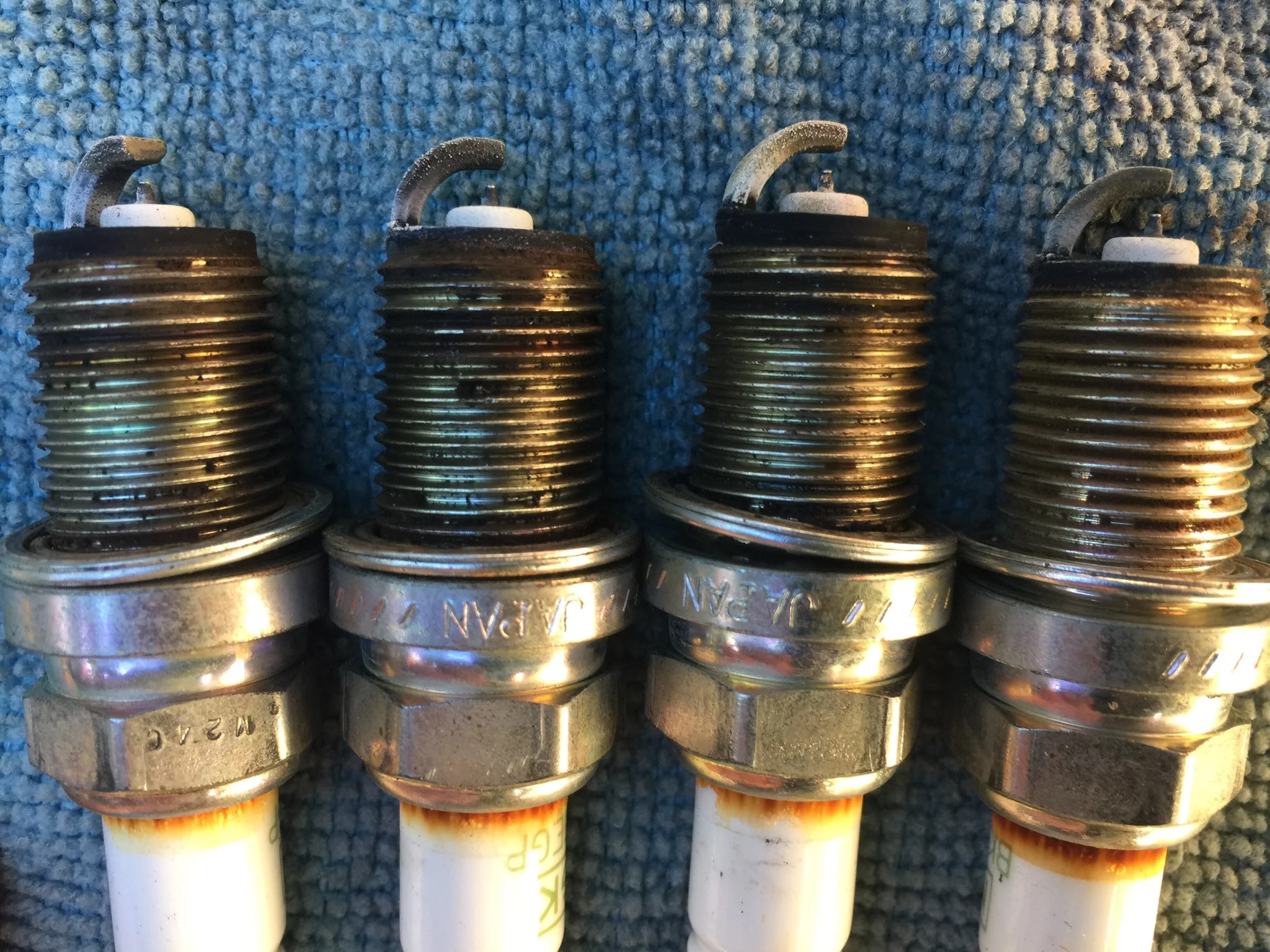
Reading the condition of old spark plugs is one of the most informative diagnostic techniques available. Each failure mode leaves a specific pattern:
Healthy plug: Light tan or grey deposits on the insulator tip. Electrode edges still relatively sharp. Normal wear consistent with service interval.
Carbon fouled (black, sooty): Rich running — too much fuel, not enough air. Causes: stuck choke, leaking fuel injector, failed O2 sensor, air filter blocked.
Oil fouled (black, oily, wet): Oil entering the combustion chamber. Causes: worn piston rings, worn valve stem seals, failing turbo seal.
Overheated/blistered (white insulator): Too hot — lean mixture, incorrect heat range, detonation. Can cause pre-ignition if left.
Worn electrode (rounded, large gap): Simply overdue for replacement. Normal wear beyond service life.
Physical damage (cracked insulator, chipped): Impact damage or incorrect installation torque. Replace immediately.
Replacing Spark Plugs — DIY or Professional?
DIY — For Most 4-Cylinder Engines
Most inline 4-cylinder engines have easily accessible spark plugs — visible on top of the engine with the ignition coils sitting directly above them.
What you need:
- Correct spark plugs for your vehicle (check your owner’s manual or parts website)
- Spark plug socket (usually 16mm or 21mm)
- Extension bar and ratchet
- Torque wrench
- Anti-seize compound (optional, check your manufacturer’s guidance)
Basic process:
- Let engine cool completely — at least 2 hours after last use
- Remove ignition coil from first cylinder (disconnect connector, remove bolt, pull coil out)
- Clean around the plug recess with compressed air or a brush before removing
- Remove old plug with spark plug socket
- Check gap on new plug against specification
- Install new plug hand-tight first, then torque to specification (typically 20–30 Nm)
- Reinstall coil
- Repeat for each cylinder
Common mistake: Overtightening. An aluminium cylinder head stripped by an overtightened spark plug is an expensive repair. Always use a torque wrench on the final tightening.
When to Use a Professional
- V6 or V8 engines where rear bank plugs are buried under the intake manifold
- Direct injection engines with tight tolerances around injectors
- Any engine where the plugs haven’t been changed in a very long time and may be seized (penetrating oil + patience required)
- If you’re not confident about the torque specification
Professional cost: £80–£200 for most 4-cylinder engines, £150–£400 for V6/V8 or complex layouts.
Choosing the Right Replacement Plugs
Match the specification: Your owner’s manual lists the specific plug part number or specification. Don’t substitute a different heat range or reach without confirming compatibility.
Upgrade to iridium: If your car currently uses copper plugs and you don’t want to change plugs every 25,000 miles, upgrading to quality iridium plugs like NGK Iridium Spark Plugs extends service intervals to 60,000–80,000 miles. The upfront cost is higher but total cost over the life of the car is comparable — with the benefit of better and more consistent performance throughout.
Replace all plugs simultaneously: When one plug is worn, the others are at the same mileage and similarly worn. Mixing old and new plugs creates uneven combustion — some cylinders firing better than others.
Don’t reuse old plug seals/gaskets: If your plugs have crush washers (older designs), use new washers. Reused washers don’t seal correctly.
Can You Jump-Start a Car With Bad Spark Plugs?
A jump-start provides extra current to the starter motor — it doesn’t affect the ignition system’s ability to produce spark. So jump-starting a car with completely dead spark plugs won’t help — the engine will crank but still won’t fire.
However, if the plugs are borderline (not completely failed, just very worn), a jump-start can occasionally help start an engine that’s been drained by repeated cranking attempts, by providing the extra current needed to get the engine turning fast enough for the worn plugs to fire. This is coincidental rather than causal — the jump-start helped the starter, not the plugs.
Bottom line: A jump-start is not a solution for bad spark plugs. Replace the plugs.
How Long Can You Drive With Bad Spark Plugs?
The honest answer depends on how “bad” they are:
Worn but still firing (rough idle, poor economy): You can drive for some time, but every mile is:
- Reducing fuel economy
- Potentially damaging the catalytic converter from partial misfires
- Gradually worsening as the plugs deteriorate further
Severely worn causing misfires: Address within days. A flashing check engine light from active misfires means stop soon — the cat is being damaged.
Completely failed (won’t start): You’re already stopped. Replace them.
The practical advice: if you’re within 10,000 miles of your plug’s service interval and experiencing any of the symptoms above — replace them now rather than waiting.
Frequently Asked Questions
How do I know if spark plugs are causing my no-start? If the engine cranks strongly (full fast turning sound) but won’t fire, and you have fuel reaching the engine (fuel pressure check, fuel smell), spark is the remaining variable. Pull one plug and inspect it — a heavily fouled or worn plug confirms the diagnosis. Or use an ANCEL AD310 OBD2 Scanner to check for misfire codes that confirm which cylinders are failing to fire.
Can bad spark plugs damage the engine? Not directly — but the misfires they cause send unburnt fuel into the catalytic converter, which can overheat and destroy it. A cat replacement costs £250–£600. Spark plugs cost £20–£80. The calculus is clear.
My car runs fine at highway speed but misfires in traffic — is that the plugs? Possibly — worn plugs often manage to fire acceptably at consistent RPM (highway cruise) but misfire at the variable throttle inputs of town driving. Also check ignition coils, as this pattern is equally consistent with a failing coil. The swap test (move the suspect coil to a different cylinder and see if the misfire code moves) confirms.
Do I need to change spark plug wires when changing plugs? On older vehicles with separate plug wires (pre-2000 roughly), yes — if the wires are original and the plugs are worn, the wires are similarly aged and should be replaced simultaneously. On modern coil-on-plug systems (one coil per cylinder, no separate wires), there are no wires to replace — just the coils if needed.
How often should spark plugs be changed? Copper plugs: every 20,000–30,000 miles. Platinum: 40,000–60,000 miles. Iridium: 60,000–100,000 miles. Check your owner’s manual for the manufacturer specification — some modern engines specify 100,000-mile iridium plugs as standard.
Is your car cranking but not starting, or running roughly? And how many miles are on your current plugs? Those two details immediately tell us whether plugs are the likely culprit — leave them in the comments.

