
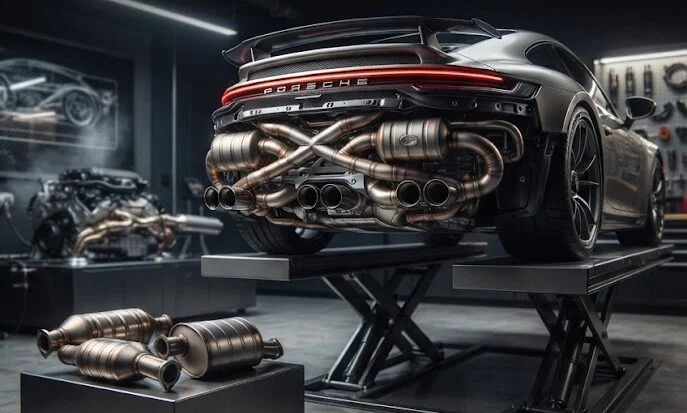
Key Takeaways
- Exhaust mods can unlock 5–30+ hp depending on the platform, but gains vary sharply between cat-back, axle-back, and full header-back systems — each with different legal, thermal, and tuning implications.
- Performance gains are only realized when supporting mods are present — a standalone cat-back on a stock NA engine yields modest results; headers without a retune on a turbocharged engine can trigger limp mode.
- Emissions compliance is the #1 legal risk: CARB-illegal components can result in failed smog inspections, registration denial, and fines up to $1,000+ in regulated states.
- Tools you’ll need for a DIY install: floor jack + stands, breaker bar, O2 sensor socket (22mm), penetrating oil (PB Blaster), torque wrench, exhaust hanger pliers, and a plasma cutter or reciprocating saw for seized sections.
Modifying your vehicle’s exhaust system is one of the most impactful — and most misunderstood — performance upgrades in automotive tuning. Whether you’re chasing dyno-proven horsepower on a turbocharged platform, trying to shed rotating mass with a titanium cat-back, or simply want that aggressive note rolling out of a V8 muscle car, the exhaust system sits at the intersection of engine thermodynamics, emissions law, acoustic engineering, and material science.
This guide cuts through the marketing noise. You’ll get exact component-level analysis, real torque specs, emissions law realities, and an honest breakdown of what each mod tier actually delivers — and what it costs you.

What Actually Happens Inside an Exhaust System
Before evaluating modifications, you need to understand what you’re modifying at a thermodynamic and fluid-dynamic level.
When the exhaust valve opens near BDC (Bottom Dead Center) on the exhaust stroke, burnt combustion gases exit at temperatures between 1,200°F and 1,650°F (650–900°C) and pressures of 30–90 PSI in naturally aspirated engines — significantly higher in forced-induction applications. The exhaust system’s job is to:
- Scavenge spent gases from the combustion chamber efficiently (header tuning and pulse scavenging)
- Reduce toxic emissions via oxidation and reduction reactions inside the catalytic converter (targeting HC, CO, and NOₓ)
- Attenuate acoustic energy (noise) through destructive interference, absorption, and expansion chambers
- Manage backpressure — a term grossly misunderstood, covered in full below
The Backpressure Myth — Clarified
You’ll hear two camps: “you need backpressure for low-end torque” vs. “eliminate all backpressure for max power.” Both are oversimplifications.
What actually matters is exhaust velocity and scavenging efficiency. Excessively large-diameter piping on a low-displacement, low-revving engine drops exhaust gas velocity, reduces the Venturi scavenging effect at the exhaust port, and hurts low-end torque. Conversely, a restrictive stock exhaust on a high-revving, high-flow engine creates pumping losses — the engine wastes energy pushing gases against restriction.
The optimal pipe diameter is a function of:
– Engine displacement
– Peak RPM target
– Volumetric efficiency
– Whether forced induction is present
General rule of thumb for naturally aspirated engines:
– Under 200 hp: 2.0–2.25″ primary pipe, 2.25–2.5″ cat-back
– 200–350 hp: 2.25–2.5″ primary, 2.5″ cat-back
– 350–500 hp: 2.5″ primary, 3.0″ cat-back
– 500+ hp: 3.0″+ depending on application
The Four Tiers of Exhaust Modification
Tier 1 — Axle-Back Systems
An axle-back replaces only the muffler and tailpipe section, from the rear axle to the exit. It’s the most affordable, least invasive entry point.
What it changes: Sound character, aesthetics, minor weight reduction
What it doesn’t change: Exhaust flow upstream, catalytic converter efficiency, header scavenging
Hp gain: 0–5 hp (often within margin of error on a dyno)
Sound change: Moderate to significant depending on muffler design
Emissions impact: None (catalysts untouched)
Legality: Legal in all 50 states when stock cats are retained
Tier 2 — Cat-Back Systems
A cat-back replaces everything from the outlet of the catalytic converter to the tailpipe exit. This is the most popular enthusiast upgrade and the sweet spot of cost-to-benefit on most daily-driven platforms.
What it changes: Exhaust flow from mid-pipe rearward, sound tuning, weight
Hp gain: 5–15 hp on naturally aspirated engines; 10–25 hp on some turbocharged platforms where the stock mid-pipe is restrictive
Emissions impact: Catalysts untouched; typically legal in all 50 states
Key components: Mid-pipe (sometimes with resonator delete), muffler, tip
Tier 3 — Header (Manifold) Upgrades
This is where genuine power is unlocked — and where complexity, cost, and legal risk escalate sharply.
Long-tube headers vs. shorty headers:
– Shorty headers (or “short-tube”): Replace the factory manifold but terminate close to the firewall. They improve mid-to-high RPM power without major routing changes. Gains: 8–15 hp. Easier to install. Often smog-legal with the right catalytic placement.
– Long-tube headers: Feature primary tubes of 28–36″ that allow full exhaust pulse tuning and scavenging optimization. They route the exhaust much further before the collector. Gains: 15–30+ hp. Require relocating or deleting catalytic converters in most applications — making them CARB-illegal and often 49-state illegal without an EO (Executive Order) number.
Primary tube diameter and length are tuned for specific RPM bands. A 1-5/8″ diameter, 32″ long primary tube on a small-block V8 optimizes torque in the 3,500–5,500 RPM range. Going to 1-3/4″ primaries pushes peak gains higher in the rev range, sacrificing some low-end.
Tier 4 — Full Header-Back / Turbo-Back Systems
On turbocharged and supercharged platforms, a full turbo-back or supercharger-back system replaces the downpipe, catalytic converter(s), mid-pipe, and cat-back as a package. This is where you see 30–80+ hp gains on high-boost applications — but these gains are meaningless without an ECU retune, and installing a decat downpipe on a modern turbocharged vehicle will almost immediately trigger a check engine light (P0420/P0421 catalyst efficiency below threshold) and may send the ECU into closed-loop correction that actively reduces power.
If you’re exploring forced-induction exhaust upgrades, understanding turbo lag and turbo spool is critical context — exhaust restriction directly impacts turbine speed recovery between gear changes.
Exhaust Mod Pros: The Real Technical Benefits
1. Measurable Power and Torque Gains
Properly matched exhaust hardware reduces pumping losses, improves scavenging, and on turbocharged engines, lowers exhaust backpressure at the turbine inlet — which reduces turbine inlet temperature and allows the compressor to build boost faster.
On a naturally aspirated 2.0L 4-cylinder, a quality cat-back + shorty headers + tune might net 18–22 hp at the wheels. On a 3.5L twin-turbocharged V6, a catted downpipe + cat-back + tune has produced 40–60 whp gains on documented dyno sheets.
2. Reduced Exhaust Gas Temperature (EGT) on Boosted Engines
Restrictive exhausts trap heat in the combustion chamber and turbo inlet. Lower EGT (ideally keeping cylinder EGT under 1,650°F on pump gas) means safer, more aggressive tuning with less risk of detonation and piston damage.
3. Weight Reduction
OEM exhaust systems are designed for durability, cost, and NVH (Noise, Vibration, Harshness) compliance. They use thick-gauge mild steel and heavy resonator chambers.
| Material | Weight (Typical Cat-Back) | Durability | Cost Premium |
|---|---|---|---|
| Mild Steel (OEM) | 28–45 lbs | High | Baseline |
| Aluminized Steel | 25–40 lbs | Moderate-High | Low |
| 304 Stainless Steel | 22–35 lbs | Very High | Medium |
| Titanium | 12–22 lbs | High | Very High |
A titanium cat-back on a sport compact can save 15–20 lbs of unsprung/rotating weight — genuinely noticeable in acceleration and handling dynamics.
4. Acoustic Tuning
This is subjective but engineered. Muffler designs fall into three categories:
– Chambered mufflers (e.g., Flowmaster Super 44): Use internal chambers to create specific acoustic tones via sound wave reflection. Aggressive, rumbling, distinctly American muscle character.
– Straight-through/perforated core mufflers (e.g., Magnaflow): Exhaust passes through a perforated core surrounded by sound-absorbing packing material. Cleaner, deeper note with less drone.
– Turbo-style mufflers: Multiple internal baffles reducing noise across frequencies. Quieter than chambered, good for street application.

Exhaust Mod Cons: The Costs Nobody Talks About
1. Emissions Compliance and Legal Liability
This is the most consequential risk for daily drivers.
CARB (California Air Resources Board) regulations require that any aftermarket exhaust component either retain the OEM catalytic converter or use a CARB-EO-certified replacement. Long-tube headers almost universally fail this requirement. Installing non-compliant components in California can result in:
– Failed Smog Check (BAR referee inspection)
– Registration denial
– Fines up to $1,000 per violation
– Required restoration to stock configuration at owner’s expense
Even in non-CARB states, EPA regulations under the Clean Air Act (Section 203(a)(3)) prohibit the removal or rendering inoperative of any emission control device. This applies to catalytic converter deletes regardless of state.
For authoritative emissions compliance guidance, the EPA’s motor vehicle regulations portal outlines federal requirements that apply even in states without their own CARB-equivalent standards.
OBD-II vehicles (1996+) are particularly unforgiving. Downstream O2 sensors (behind the cat) monitor catalyst efficiency in real time. A decat setup will trigger P0420/P0421 immediately unless:
– An O2 sensor simulator/fooler is used (itself federally illegal for road use)
– The ECU is tuned to disable rear O2 monitoring (loses actual fuel trim feedback data)
2. Drone and NVH Degradation
Highway drone is the #1 complaint of inexperienced exhaust builds. It occurs when exhaust note frequency resonates with the vehicle’s cabin at specific RPM ranges — typically 1,800–2,500 RPM (common highway cruise RPM on modern geared transmissions).
Causes:
– Muffler design producing dominant frequencies in the 80–150 Hz range
– Removal of OEM resonator without replacement
– Excessive pipe diameter reducing gas velocity (lower velocity = lower frequency, more prone to drone)
Mitigation:
– Use a resonator in the mid-pipe position
– Select a straight-through muffler rather than chambered
– Avoid going oversized on pipe diameter for your power level
– Consider a Helmholtz resonator on problem frequencies
If your car is already exhibiting unusual noise before modifications, it’s worth diagnosing the root cause first — our detailed breakdown at why is my car so loud covers stock noise sources that may be mistaken for exhaust issues.
3. Check Engine Lights and ECU Complications
Beyond catalyst codes, aggressive exhaust mods on modern vehicles equipped with variable valve timing systems (VVT, VTEC, VANOS, AVCS) can alter exhaust cam timing response. The ECU interprets changed exhaust scavenging as a VVT malfunction and may set codes. This is especially prevalent on:
– Honda K-series engines with i-VTEC
– BMW N-series with Double VANOS
– Subaru FA/FB series with AVCS
Resolution typically requires a custom tune reflash to update target tables.
4. Installation Complexity and Seized Hardware
On vehicles with more than 5–6 years of exposure, exhaust hardware seizure is a genuine shop-floor problem. Exhaust flange studs (typically M8 x 1.25 or 3/8″-16 thread pitch) corrode into the cylinder head or exhaust manifold and snap during removal.
Standard torque specs for common exhaust hardware:
– Exhaust manifold to cylinder head (cast iron manifold, steel stud): 20–25 ft-lbs with anti-seize
– Exhaust manifold to cylinder head (aluminum head, steel stud): 15–22 ft-lbs — critical to not overtighten into aluminum threads
– Collector flange bolts (mid-pipe to header): 25–35 ft-lbs
– Cat-back flange bolts: 25–40 ft-lbs (varies by OEM spec)
– O2 sensor: 27–33 ft-lbs (22mm sensor socket, apply anti-seize to threads, NOT to sensor tip)
Pro tip: Apply PB Blaster or Kroil 24–48 hours before attempting removal. Heat the flange/stud area with a propane torch until glowing red (~1,200°F) before attempting extraction. Snapped studs require an extractor kit or, in worst cases, re-tapping the head — a significant labor cost.
Comprehensive Exhaust Mod Cost and Gain Matrix
| Mod Type | Avg Cost (Parts) | Avg Install Labor | Est. HP Gain | Emissions Safe? | Drone Risk | ECU Tune Required? |
|---|---|---|---|---|---|---|
| Axle-Back | $150–$600 | 1–2 hrs / $80–$160 | 0–5 hp | Yes (all 50 states) | Low–Moderate | No |
| Cat-Back (mandrel bent) | $400–$1,500 | 2–4 hrs / $160–$320 | 5–15 hp | Yes (all 50 states) | Moderate | Recommended |
| Shorty Headers | $300–$900 | 4–8 hrs / $320–$640 | 8–15 hp | Maybe (CARB EO req.) | Low | Recommended |
| Long-Tube Headers | $600–$2,500 | 8–16 hrs / $640–$1,280 | 15–30 hp | Rarely (off-road only) | Low | Yes |
| Catted Downpipe (turbo) | $400–$1,200 | 3–6 hrs / $240–$480 | 15–35 hp | Maybe (200-cell cat) | Low | Yes |
| Decat Downpipe (turbo) | $200–$600 | 2–4 hrs / $160–$320 | 20–45 hp | No (CARB/EPA illegal) | Low | Yes |
| Full Turbo- |

