
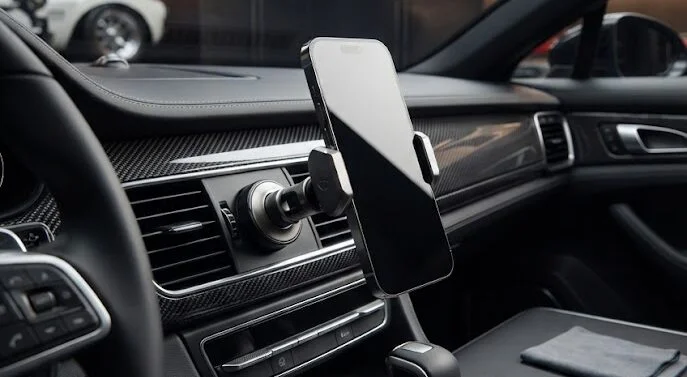
Key Takeaways / Quick Answer
- Best overall phone mount location: The dashboard (lower-center stack area) offers the optimal balance of sightline proximity, reach ergonomics, and legal compliance in most U.S. states.
- Windshield mounts are restricted or outright illegal in California, Minnesota, Texas, and several other states — always check your local DMV regulations before installing.
- Mount types to evaluate: Suction cup, adhesive pad, vent clip, CD slot, cupholder base, and magnetic plate — each with distinct vibration resistance, viewing angle, and phone compatibility trade-offs.
- Critical safety rule: Your phone mount must never intersect the primary forward sightline (the critical 30cm/12-inch zone directly ahead of the driver per NHTSA distracted driving guidelines).
Why Phone Mounting Position Is an Engineering Problem, Not Just a Preference
Most drivers treat phone mounting as an afterthought — something handled with a $7 clip from a gas station display rack. That’s a mistake with real consequences. Cognitive distraction research published by the AAA Foundation for Traffic Safety shows that even voice-activated phone interaction generates a 27-second attentional deficit after task completion. The physical placement of your phone determines how much head movement, focal plane shifting, and hand reach is required — all of which compound that cognitive load.
From a pure biomechanics standpoint, every degree your neck rotates away from the road centerline, every additional inch your arm extends to tap a screen, and every second your eyes spend re-acquiring focus from near-field (phone screen) to far-field (road ahead) increases accident risk exponentially at speed. At 60 mph, your vehicle travels 88 feet per second. A 1.5-second glance at a poorly positioned phone — mounted low on a center console, for example — means you’ve traveled 132 feet effectively blind.
This guide breaks down every mounting position using real criteria: viewing angle delta, reach envelope, vibration dampening, thermal exposure, legal compliance, and interaction with ADAS systems.

The Complete Phone Mount Location Comparison Matrix
Before diving into individual mounting positions, use this diagnostic matrix to match your specific driving profile to the correct solution:
| Mount Location | Sightline Impact | Reach Distance | Vibration Resistance | Legal Risk (US) | Best For | Worst For |
|---|---|---|---|---|---|---|
| Windshield (upper-center) | Low – near eye level | Medium (18–22 in) | Moderate | HIGH – banned in 8+ states | GPS-dependent drivers in legal states | Tall drivers, UV-heavy climates |
| Dashboard (adhesive pad) | Very Low – below sightline | Short (12–16 in) | High | LOW – widely legal | Daily commuters, navigation-heavy use | Rental cars, leased vehicles |
| HVAC Vent Clip | Low – mid-level position | Short (10–14 in) | LOW – vent flex is a problem | Very Low | Short-trip urban drivers | Highway vibration, heavy phones (>210g) |
| CD Slot Mount | Moderate – angle dependent | Short (10–13 in) | Very High | Very Low | Older vehicles with OEM CD units | Vehicles with infotainment delete |
| Cupholder Base (extended arm) | HIGH – driver must look down | Medium (14–18 in) | Moderate | Very Low | Passengers using phone | Any safety-conscious mounting use |
| Magnetic Dashboard Pad | Very Low | Short (12–15 in) | High (pad adhesion) | Low | Quick-attach/detach users | Phones with large battery packs (some interference) |
| Rear-View Mirror Clip | Moderate-High | Long (22–28 in) | Low – mirror vibration | Moderate | Backup camera overlay viewing | Primary navigation use |
| Steering Column / Wheel | CRITICAL – airbag zone | Minimal | Moderate | ILLEGAL in all jurisdictions | Nothing | Everything |
| Sun Visor Clip | HIGH – obstructs forward vision | Long | Low | High | N/A – not recommended | All driving scenarios |
| Passenger-Side Dash (right) | High – lateral head turn required | Very Long | Moderate | Low | Passenger-operated navigation only | Driver solo use |
Position 1: Windshield Mount — The Most Common Choice With Hidden Compliance Risks
The windshield mount is the default recommendation across most casual automotive advice, but the engineering reality is more nuanced. A properly installed windshield mount — positioned in the upper-center zone, approximately 2–3 inches below the top edge and centered on the A-pillar midline — places the phone screen roughly 6–8 degrees below the driver’s natural forward gaze angle. That’s within acceptable ergonomic range for brief glances.
Suction Cup Mounting Physics: Commercial-grade suction cups (e.g., iOttie EASY One Touch 5, RAM Mounts X-Grip series) use a vacuum seal maintained by atmospheric pressure differential. A properly sized cup on clean glass should sustain approximately 18–22 lbs of holding force in static conditions. The problem is thermal cycling. On a black dashboard in direct sun, interior temperatures can reach 140–160°F (60–71°C). At those temperatures, the thermoplastic elastomer in budget suction cups deforms, and you lose 30–40% of holding force. This is why phones “fall off” on hot days — it’s not the suction cup failing; it’s the polymer creeping under thermal load.
Legal Compliance: Per California Vehicle Code §26708, windshield-mounted devices are restricted to a 7-inch square in the lower-driver’s corner or a 5-inch square in the lower-passenger corner. Minnesota Statute §169.71 bans all windshield obstructions except GPS units under specific size limits. Texas, New Jersey, and Illinois have similar language. Always verify with your state DMV or check NHTSA’s distracted driving resource portal at nhtsa.gov for state-by-state guidance.
Best Windshield Mount Products (Technical Specs):
– RAM Mounts RAM-B-166-UN7U: 3.3 lb rated suction force per manufacturer, 1-inch ball system, compatible with X-Grip holders for phones up to 3.25 inches wide
– iOttie Easy One Touch 5: Telescoping arm, foot pedal suction lock, rated to 1.1 lbs static load
– Spigen OneTap Pro: Internal spring mechanism, MagSafe compatible, 2.56–3.86 inch width range
Position 2: Dashboard Mount — The Safest and Most Universally Legal Option
The dashboard mount, when installed correctly, is the closest approximation of a factory-integrated infotainment display position. Modern OEM infotainment screens are positioned at approximately 15–20 degrees below horizontal sightline and 0–5 degrees of lateral offset from the driver’s centerline. A dashboard phone mount in the lower-center stack area replicates this geometry.
Adhesive Pad Technology: High-quality dashboard mounts use 3M VHB (Very High Bond) tape rated at 90+ oz/in² tensile strength, or nano-suction pads that create mechanical interlocking with surface texture rather than true vacuum. The distinction matters: VHB adhesives bond chemically and thermally — they actually improve holding strength at elevated temperatures unlike suction cups. However, removal leaves residue, making them inappropriate for leased or financed vehicles.
Dashboard Material Considerations: Soft-touch TPO (thermoplastic polyolefin) dashboards — standard in most post-2015 vehicles including most Honda, Toyota, and German marques — are notoriously problematic for adhesive mounts. The micro-texture and flex of TPO panels means standard adhesive pads experience peel-force failure over time. For these surfaces, look for mounts with gel-pad technology (e.g., Beam Electronics Universal Dashboard Mount) that conform to surface irregularities.
One critical factor drivers overlook when installing dashboard mounts: proximity to airbag deployment zones. The passenger-side airbag cover on most vehicles has a deployment radius of 12–18 inches. Installing a dashboard mount within that radius on the passenger side creates a shrapnel hazard during airbag deployment. Keep dashboard mounts to the driver-side lower stack area only.
Position 3: HVAC Vent Clip Mount — Convenient But Mechanically Compromised
Vent clip mounts are the most purchased phone mount category in the U.S. market, primarily due to their sub-$15 price point and zero-residue installation. Mechanically, however, they’re the weakest solution for consistent, safe mounting.
The Vibration Problem: HVAC vents are connected to the dashboard structure via plastic snap clips — a deliberately compliant mounting arrangement that allows vent adjustment. This means the vent assembly itself has 2–4mm of play in multiple axes. Under highway driving conditions (road roughness, engine vibration transmitted through the chassis), this play induces resonant oscillation in the phone mount at frequencies between 15–30 Hz. At those frequencies, a 200g phone generates 0.4–0.8 N of dynamic load at the vent clip — enough to fatigue and crack OEM vent vanes within 6–12 months on vehicles with thinner plastic construction.

Thermal Issue: Positioning your phone directly in front of an active HVAC vent exposes it to temperature extremes. In winter, a blast of cold air from a 32°F ambient can shock a phone battery from 70°F operating temperature to sub-40°F in under 2 minutes — triggering false low-battery warnings and temporary performance throttling in lithium-ion cells. In summer, hot air from the vent (pre-cool-down period) can push phone skin temperature above the 95°F (35°C) thermal throttling threshold for most iOS and Android devices.
When Vent Mounts Work: Short urban trips, lighter phones (under 180g), vehicles with robust vent construction (most German marques use die-cast aluminum vent bezels that don’t flex), and temporary use cases.
Position 4: CD Slot Mount — The Underrated Champion for Older Vehicles
If your vehicle has a factory CD player (pre-2018 most domestic trucks and non-premium sedans), the CD slot mount is arguably the most mechanically sound aftermarket option available. The CD slot opening connects directly to the head unit chassis — a steel or reinforced polymer structure bolted to the dashboard crossmember. That means your phone mount is effectively bolted to the vehicle’s structural core.
Installation Mechanics: CD slot mounts use a spring-loaded insertion tab system. The tab engages the CD transport’s internal guide rails, providing 3–4 lbs of resistance force. Lateral stability comes from the tight fit of the tab within the slot aperture (typically 1.2mm clearance). Vibration transmission is significantly lower than vent mounts because the mounting substrate has no compliance — steel doesn’t flex at highway vibration frequencies.
Compatibility Check: Before purchasing, verify your head unit’s CD slot depth (most require 60mm minimum insertion depth) and confirm the slot isn’t part of a slot-loading transport that uses drive rollers. Mount tabs can damage roller-style transports. Motorized drawer-style units are safe for CD slot mounts.
Position 5: Cupholder Base Mounts — Functional Ergonomics and a Major Safety Caveat
Cupholder base mounts use a weighted base or expanding plug system to anchor in the cupholder recess, with an articulating arm extending the phone upward and forward toward the driver. The mechanical advantage here is that cupholders are molded directly into the center console structure — far more vibration-resistant than HVAC vents.
The critical problem is geometry. Even with a 6–8 inch extended arm, the phone screen sits significantly lower than optimal sightline level — typically 25–35 degrees below horizontal gaze angle. Research from the University of Utah’s Applied Cognition Lab indicates that downward gaze angles beyond 20 degrees require full head-tilt reorientation rather than simple eye movement. That means every navigation glance requires you to physically look down, breaking your road scan pattern entirely.
Use Case: Cupholder mounts are genuinely useful for passengers managing navigation, or for stationary vehicle use. As a primary driver mount for moving vehicles, the ergonomics simply don’t support safe use.
If you’re also focused on broader vehicle ergonomics and interior condition, it’s worth noting that maintaining your cabin environment extends beyond mount placement — understanding how to fix cigarette burns in cars is similarly the kind of interior detail work that separates a properly maintained vehicle from a neglected one.
Position 6: Magnetic Phone Mounts — Modern Solution With Important Nuances
Magnetic mounts consist of two components: a ferrite or neodymium magnet assembly in the mount head, and a metal plate (typically 430 stainless steel, 0.5–0.8mm thick) that adheres to the back of the phone or inside the phone case. Separation force on quality units (e.g., Scosche MagicMount Pro, Moment MagSafe Mount) ranges from 6–14 lbs depending on magnet grade.
Does the Magnet Harm Your Phone? This is the most common technical question. Modern smartphones use NAND flash storage — no magnetic media. Compass sensors (Hall effect sensors) can be temporarily disrupted by strong rare-earth magnets at close range, but neodymium grades used in phone mounts (N35–N52) typically generate fields of 0.3–0.5 Tesla at contact surface, dropping to under 0.01 Tesla at 10mm distance. That’s insufficient to cause permanent sensor damage or data corruption.
The caveat: phones with wireless charging coils and certain UWB (ultra-wideband) precision finding chips can experience interference if the metal mounting plate is positioned directly over these components. For iPhones 12 and later with MagSafe, use MagSafe-compatible magnetic mounts that align with the OEM magnet ring — this eliminates the metal plate entirely.

State-by-State Legal Overview: What Your Mount Position Must Comply With
Understanding the regulatory landscape is non-negotiable. Phone mount laws have evolved rapidly since 2015, and enforcement is active in most metropolitan jurisdictions.
| State | Windshield Mount Legal? | Dashboard Mount Legal? | Handheld Use Fine (1st offense) | Notes |
|---|---|---|---|---|
| California | Restricted zones only (§26708) | Yes | $162 base + penalty assessments | Screen must be viewable in “landscape” |
| New York | No | Yes | $200–$400 | Must be hands-free operation |
| Texas | No restriction on mount type | Yes | $99–$200 | City-level ordinances may vary |
| Florida | No restriction on mount type | Yes | $30 first offense | Must not impair required view |
| Minnesota | Banned entirely | Yes | $50–$275 | GPS exception for small units |
| Washington | Restricted to 5″ square bottom corners | Yes | $136 | Emphasis on interactive use prohibition |
| Illinois | Lower corners only (similar to CA) | Yes | $75–$150 | Must not obstruct airbag deployment |
Always verify with your state’s current DMV statutes — laws change frequently.
Installing Your Mount Correctly: Professional Shop Techniques
Regardless of which mounting position you choose, installation quality determines longevity and safety. Here’s how mechanics approach this:
Surface Preparation for Adhesive Mounts:
1. Clean the mounting surface with 70% isopropyl alcohol on a lint-free cloth. Allow 5 minutes of flash-off time before applying any adhesive.
2. For textured dashboards, use a heat gun (or hair dryer on high) to warm the surface to

